

What is Papad?
Everything You Need to Know About India’s Favourite Crunchy Snack.
If you have ever stepped into an Indian household during lunchtime, you have likely heard a distinct "crunch" echoing through the dining room. That sound comes from the Papad - a thin, crisp, disc-shaped food that is an inseparable part of Indian culinary heritage. But what is papad, and why is it so globally popular today?
Understanding the Basics of Papad
A papad (also known as pappadam, appalam, or poppadom) is a traditional Indian flatbread that is dried and then cooked using dry heat (roasting) or deep-frying. Traditionally, it is made from pulses or lentil flour - most commonly urad dal (black gram), moong dal (green gram), or chickpeas.
However, modern innovations like those from Noble Agro have expanded the category. Today, you can find a wide variety of papads made from Rice (Chawal), Potato (Aloo), Sago (Sabudana), and even Ragi (Millet) to cater to health-conscious consumers.

The History Of Papad In India
The history of papad in India is a fascinating journey from a humble household necessity to a global snack phenomenon. While there is no single "inventor" of the papad, its roots are deeply embedded in the ancient Indian practice of food preservation.
1. Ancient Origins: The Art of Preservation
The concept of the papad dates back over 2,000 years. In ancient India, before refrigeration, the primary challenge was preserving seasonal produce.
-
Lentil Science: Ancient Ayurvedic texts mention Parpata, a thin wafer made from pulses. This was likely the precursor to the modern "Papad."
-
Sun-Drying: Indians mastered the art of sun-drying dough made from lentils (Urad, Moong) and spices. By removing moisture, they created a product that could last for months without spoiling, providing a vital source of protein during dry seasons.
2. Regional Diversification
As the papad traveled across the Indian subcontinent, it adapted to local climates and crops.
-
The North & West (Rajasthan/Gujarat): In these arid regions, water was scarce, and pulses grew abundantly. This led to the creation of the classic Urad Dal Papad and the Khichiya Papad (made from rice flour).
-
The South (Tamil Nadu/Kerala): Here, it became the Appalam or Pappadam. These versions often have a distinct texture—the Kerala Pappadam is famous for "puffing up" into a golden ball when fried, thanks to a different fermentation and leavening process.
3. Technological Evolution: From Terrace to Factory
Until the late 1980s, papad was almost exclusively a cottage industry. However, the rise of companies like Noble Agro changed the landscape.
-
Mechanization: The introduction of high-speed extruders and automatic dryers allowed for mass production while maintaining the "handmade" thinness.
-
New Bases: While lentils were the king, the late 20th century saw the explosion of Potato (Aloo) Papads and Rice Pellets. These were easier to mass-produce as "ready-to-fry" snacks.
4. The Modern Era: Global & Healthy
Today, the papad has outgrown the "side-dish" label. It is now a Global Snack Pellet.
-
Global Map: With the advent of export-quality brands, papads are now found in supermarkets from London to Dubai.
-
Health Conscious: The shift toward Rice, Potato, and Ragi pellets has made papads a favorite for those looking for gluten-free, roasted alternatives to greasy potato chips.
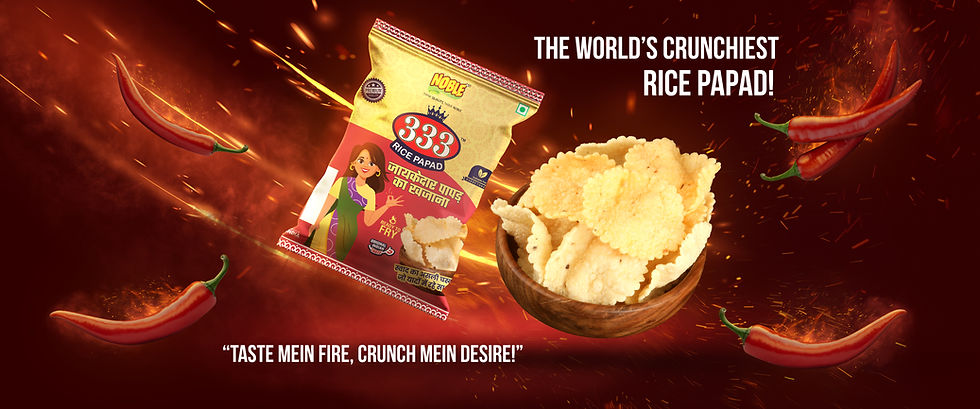
Types of papad Noble Papad has
1. Rice-Based Papads (Chawal / Khichiya)
Noble Agro is famous for its rice pellets. These are a favorite because they turn snowy white and incredibly light when cooked.
-
The Texture: Extremely crispy and airy.
-
Unique Selling Point: Naturally gluten-free and absorbs less oil compared to lentil variants.
-
Varieties: Plain Rice, Jeera (Cumin) Rice, and spicy Masala Rice.
2. Potato-Based Papads (Aloo)
Potato pellets are the bridge between a traditional papad and a modern potato chip.
-
The Texture: Dense, crunchy, and "melt-in-the-mouth."
-
Unique Selling Point: Offers that rich, earthy potato flavor that is universally loved. It is often the top choice for kids and tea-time snacking.
-
Combination: Often blended with rice (like your new product) to create a "hybrid" papad that is both light and flavorful.
3. Sago / Tapioca Papads (Sabudana)
Commonly known as "Sabudana Papad," these are a staple in Indian households, especially during fasting (Vrat) seasons.
-
The Texture: They feature a unique "beaded" look and provide a very hard, satisfying crunch.
-
Unique Selling Point: High energy and completely grain-free. When fried, they expand significantly into beautiful, white pearls.
4. Traditional Pulse-Based Papads (Urad)
These are the "Original" Indian papads that Noble Agro has perfected through mechanization.
-
The Texture: Thin, brittle, and savory.
-
Unique Selling Point: High in protein and seasoned with strong spices like Hing (Asafoetida) and Black Pepper.
-
Varieties: Punjabi Masala (Spicy), Garlic (Lassan), and Moong Special.
5. Multi-Grain & Millet Papads (The Health Range)
Following the "No Compromise" philosophy of Noble Agro also produces pellets using "Super-grains."
-
Ragi (Finger Millet): High in calcium and iron, these have a dark, rustic color and a nutty taste.
-
Maize (Corn): Bright yellow pellets that have a popcorn-like sweetness.
6. New-Age "3D" & Shaped Pellets
Using advanced Extrusion Technology, Noble Agro creates papads in shapes that go beyond the round disc:
-
Shapes: Stars, Hearts, Rings, Wheels (Ratna), and Tubes (Pipes).
-
Market: These are massive in the "HoReCa" (Hotel/Restaurant/Cafe) sector and as school-tiffin snacks for children.

How Papad is Made: From Traditional Sun-Drying to Modern Industrial Extrusion
Whether it is the centerpiece of a festive thali or a crunchy companion to your evening tea, the papad is a marvel of culinary engineering. But have you ever wondered about the journey of this thin wafer from a ball of dough to a shelf-stable snack?
The process of how papad is made has evolved from labor-intensive hand-rolling on village terraces to high-tech automated lines at facilities like Noble Agro. Here is a deep dive into both the traditional and industrial manufacturing processes.
1. The Traditional Method: The Artisanal Touch
The traditional way of making papad is a communal activity, often led by women in rural India. It relies heavily on manual skill and natural weather conditions.
Step 1: Dough Preparation
The process begins with grinding pulses (like Urad or Moong dal) into a fine flour. This flour is mixed with water, salt, and spices such as black pepper, cumin, and asafoetida (hing). A key ingredient used here is Papad Khar (an alkaline salt), which helps in the expansion and crispiness of the papad.
Step 2: The Pounding
The dough is extremely tough. Traditionally, it is beaten with wooden mallets or heavy rollers to make it pliable and soft. This "pounding" ensures that the proteins in the lentils develop the right texture.
Step 3: Hand-Rolling
Small balls of dough (loyas) are hand-rolled using a rolling pin (belan) into paper-thin circles. This requires immense precision to ensure the thickness is uniform across the entire disc.
Step 4: Sun-Drying
The rolled papads are spread out on mats or clothes under the direct sun. They are flipped periodically to ensure even drying. Depending on the heat, it takes 24 to 48 hours for the moisture to drop below 10%, making them "snap" easily.
2. The Industrial Method: The Noble Agro Way
In a modern industrial setup, technology replaces manual labor to ensure hygiene, consistency, and massive scale. This is how Unfried Snack Pellets are produced for the global market.
Step 1: Automated Mixing and Conditioning
Large-scale mixers blend flours (Rice, Potato, or Lentil) with water and seasonings. Computerized sensors ensure that the moisture level is exact every single time, something impossible to achieve by hand.
Step 2: Extrusion and Sheeting
For modern shapes (like 3D wheels, stars, or pipes), the dough passes through an Extruder. For traditional round papads, the dough is passed through heavy-duty rollers that "sheet" the dough to a precise thickness (measured in millimeters).
Step 3: Die-Cutting
The sheets move on a conveyor belt under a rotary cutter. This "cookie-cutter" system stamps out thousands of perfectly circular papads every minute, ensuring zero wastage of dough.
Step 4: Controlled Drying (The Critical Phase)
Unlike the traditional sun-drying method - which is exposed to dust and birds - industrial papads are dried in multi-stage hot air dryers.
-
Precision: The temperature and humidity are controlled at every stage.
-
Safety: This ensures a "Clean Label" product free from environmental contaminants.
Step 5: Packaging
The dried pellets are cooled and packed in moisture-proof laminates. Because the industrial process removes moisture so effectively, these papads can stay fresh upto 12 months
Homemade vs. Machine-Made Papad: The Ultimate Comparison
When it comes to India's favorite crunch, the debate between homemade and machine-made papads is always sizzling. Whether you are a fan of the traditional terrace-dried taste or the high-tech precision of brands like Noble Agro, understanding the difference is key for every snack lover.
1. Hygiene & Safety
• Homemade: Traditionally dried on open terraces or mats. While authentic, they are exposed to environmental dust, birds, and insects.
• Machine-Made: Produced in a "No Compromise" sterile environment. Industrial dryers use filtered hot air, ensuring the product is 100% germ-free and "Clean Label."
2. Consistency & Texture
• Homemade: Since they are hand-rolled, the thickness varies. This can lead to uneven frying—some parts might stay raw while others burn.
• Machine-Made: Automated rollers and die-cutters ensure every papad has the exact same thickness (down to the millimeter), leading to uniform expansion and a perfect crunch every time.
3. Oil Absorption
• Homemade: Hand-pounded dough often has uneven air pockets, which can soak up more oil during deep frying.
• Machine-Made: Advanced extrusion and sheeting technology creates a dense, uniform structure that absorbs significantly less oil, making it a healthier choice.
4. Shelf Life
• Homemade: Depends heavily on weather conditions. If not dried perfectly by the sun, they can develop mold or a "stale" smell within months.
• Machine-Made: Precision moisture control reduces water content to less than 10%, giving them a stable shelf life of 12–18 months without preservatives.
5. Production Scale
• Homemade: Limited to small batches, making it difficult to find the same taste twice.
• Machine-Made: Built for the global stage. Brands like Noble Agro can produce tons of consistent, high-quality unfried snack pellets to meet international demand.
Final Verdict
While homemade papads carry the nostalgic charm of "Dadi-Nani's" kitchen, Machine-Made papads are the winners for the modern, health-conscious, and global consumer who values safety, consistency, and a lighter bite.
Next time you snack, choose the precision of technology!